


From an idea to framework
We started with an early proof of concept exploring how AI skills could be authored through natural language and executed within QuillBot's existing AI Chat experience.
The challenge wasn't simply making these workflows possible. It was figuring out how to make them useful, intuitive, reliable, and commercially viable.
I worked within an iterative design process that brought together rapid prototyping, user testing, conversation mapping, and collaboration with engineering and AI alignment. Rather than committing to a fixed solution too early, we continuously tested our assumptions and refined the experience based on what we learned.
Our first skill, claim verification, became an important test case for the broader framework.
One of the key design challenges was deciding how much work AI should do for users.
Early prototypes allowed users to accept rewrite suggestions with a single click. During testing, we observed people accepting recommendations without reading or understanding them.
For a product serving students and writers, this raised an important question: were we helping people improve their work, or simply helping them bypass the thinking behind it?
We explored ways to explain recommendations before offering rewrites, encouraging users to engage with the reasoning and return to primary sources when needed.
This also introduced a commercial tension. Rewrite usage was connected to product entitlements, so changing how people interacted with suggestions could affect conversion and usage patterns.
The solution wasn't to force users through explanations or deliberately hide useful actions. It was to find a balance between helping people understand their writing and giving them the flexibility to work in their preferred way.

A convincing prototype doesn't necessarily make a dependable product.
As we moved towards implementation, we worked closely with engineering and AI alignment to stress-test workflows against different types and lengths of content, unexpected conversational behaviour, and potentially harmful outputs.
We also examined bias, identity-based discrimination, privacy risks, and the clarity of how results were generated.
These evaluations exposed gaps that couldn't be solved through interface design alone. The experience depended on the behaviour of the underlying model, the instructions guiding it, and the safeguards around it.
The design challenge was to make these limitations visible, handle failures gracefully, and build an experience users could trust — while recognising that the responsibility for reliability extended well beyond the interface.
Learning from real usage
Claim verification reached approximately 7,000 unique daily users within weeks of its rollout.
However, adoption also revealed the cost of running agentic workflows. Some users could generate substantial inference costs, even behind a premium subscription.
We introduced daily and weekly usage limits to help keep the experience commercially sustainable.
User testing surfaced another important insight: people weren't keen to intervene through the chat input, and they found responses too verbose, slow, and difficult to navigate in the available space.
This challenged our assumption that conversational AI was the best interface for every workflow.
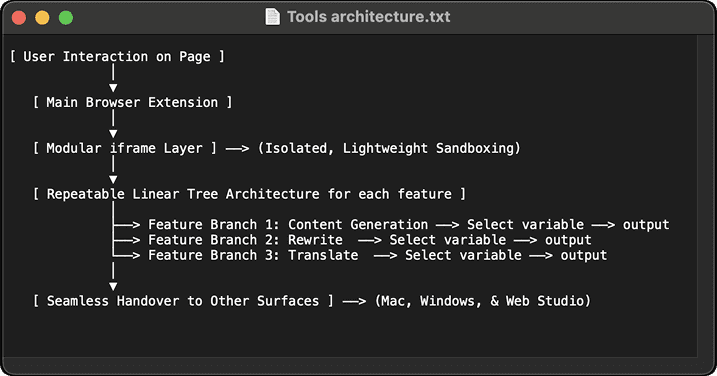
We began moving towards standalone modules that made individual skills more focused and accessible, while keeping them connected to adjacent writing capabilities such as plagiarism checking and AI detection.
By September 2026, claim verification was in beta as a standalone module, with AI grading and other specialised skills in the pipeline.

The larger opportunity was never just to launch one successful AI skill. It was to establish a framework through which QuillBot could introduce, validate, and scale new writing workflows more efficiently.
Each new capability could attract users through dedicated landing pages while creating more reasons for existing users to stay within the Writing Studio ecosystem.
As users moved between capabilities — discovering plagiarism checking, for example, and returning to verify claims — the value of the broader product experience could compound.

This project reinforced that designing AI products is as much about knowing what not to automate as it is about exploring what AI makes possible.
The interface is only one part of the system. Useful AI experiences require thoughtful interaction models, continuous user discovery, reliable model behaviour, and a sustainable business model.
Working alongside Nathan and a multidisciplinary team, I contributed to shaping an emerging product direction into a more scalable approach to agentic writing support — one designed to evolve with both user needs and the technology.
